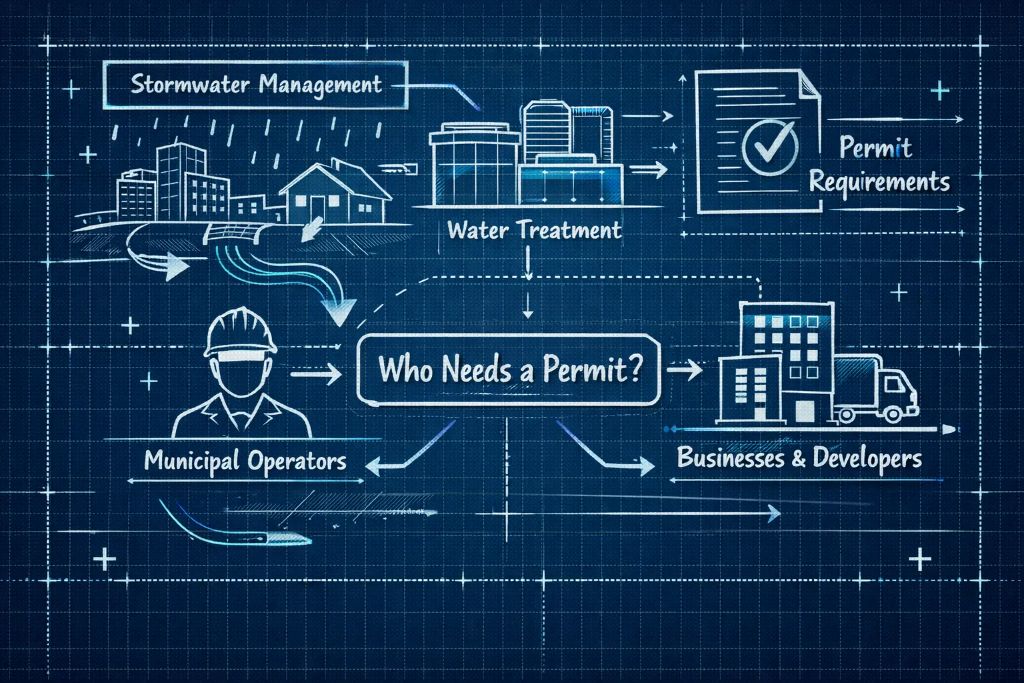
If your city or county operates a storm sewer system that discharges to a waterway, you almost certainly need a municipal stormwater permit under federal law. This is not a niche regulatory corner that only affects the largest cities. Roughly 7,550 municipal systems across the U.S. operate under some form of NPDES MS4 permit coverage, and that number spans everything from major metro areas to small townships and public universities.
Yet public works teams are still routinely caught off guard by what that coverage actually requires, which phase they fall under, and what compliance looks like day to day. This guide breaks all of that down so you walk away knowing exactly where your system stands and what to do next.
What a Municipal Stormwater Permit Actually Covers
The regulatory foundation sits in Section 402 of the Clean Water Act, which requires a National Pollutant Discharge Elimination System (NPDES) permit for any point source discharge of pollutants to U.S. waters. Stormwater runoff from city streets picks up oils, sediment, and contaminants before flowing directly into rivers and lakes through storm drains with no treatment whatsoever. That untreated flow is exactly what the NPDES municipal stormwater permit program addresses.
The term "municipal separate storm sewer system" (MS4) refers to any publicly owned conveyance system designed to collect stormwater, kept separate from the sanitary sewer. That includes streets, catch basins, storm drains, and outfalls. Because these systems discharge directly to waterways without treatment, the EPA established a dedicated permit framework for them, distinct from industrial or construction stormwater permits.
In most states, including Ohio, the EPA has delegated NPDES permitting authority to state environmental agencies. Ohio operators work through Ohio EPA under that delegated authority. Permits are issued either as individual permits tailored to a specific system or as statewide general permits covering many MS4s under common conditions. Knowing which type applies to your system is the starting point for everything else.
Phase I vs. Phase II: Which Permit Applies to You?
Phase I MS4 Permits
Phase I of the MS4 program, established in 1990, applies to medium and large municipal separate storm sewer systems serving populations of 100,000 or more. Approximately 855 Phase I MS4 permits are active across the country, and these systems are typically covered under individual permits rather than general permits. Phase I permits carry more rigorous monitoring and sampling requirements than what Phase II operators face.
Phase II MS4 Permits
Phase II, finalized in 1999, expanded coverage significantly. Small MS4s located within U.S. Census-defined urbanized areas are required to obtain permit coverage even if they serve far fewer than 100,000 people. Phase II also brought in systems that regulators classify as non-traditional MS4s — public universities, state departments of transportation, hospitals, prisons, and military bases that meet population or urbanized area thresholds. Roughly 6,695 Phase II MS4s now operate under coverage, most under statewide general permits.
| Feature | Phase I | Phase II |
|---|---|---|
| Established | 1990 | 1999 |
| Population Threshold | 100,000+ | Urbanized areas (any size) |
| Active Permits | ~855 | ~6,695 |
| Permit Type | Typically individual | Typically statewide general |
| Monitoring | Formal water quality sampling | Objective metrics, annual eval |
| Entities Covered | Large cities/counties | Small cities, universities, DOTs, hospitals |
Permitting authorities can designate systems outside urbanized areas for permit coverage based on water quality impact. If your system contributes to an impaired waterway or drains to a sensitive receiving body, you may be designated for coverage regardless of population or location. Verify your designation status directly with your state NPDES authority rather than assuming your system is exempt.
The Six Minimum Control Measures Every SWMP Must Include
Your stormwater management program (SWMP) must address six specific control measures. The first three face outward toward the public and your discharge infrastructure:
- Public Education and Outreach — Informing the public about stormwater pollution impacts, proper disposal practices, and how individual actions affect water quality
- Public Involvement and Participation — Creating mechanisms for community participation in stormwater program development and implementation
- Illicit Discharge Detection and Elimination (IDDE) — Mapping outfalls, screening for unauthorized discharges, investigating sources, and eliminating illegal connections to the storm sewer
The remaining three measures focus on construction activity and municipal operations:
- Construction Site Stormwater Runoff Control — Enforcing local ordinances governing erosion and sediment controls at active construction sites per your SWPPP requirements
- Post-Construction Stormwater Management — Ensuring long-term stormwater controls remain functional at completed development sites
- Pollution Prevention and Good Housekeeping — Managing your own municipal operations, from vehicle maintenance facilities to street sweeping schedules
Each of these six measures requires documented best management practices (BMPs), measurable goals, and records showing implementation. Documenting your intent is not enough. Regulators will ask whether you followed through, whether you did enough of it, and whether you can prove it. The SWMP is both a planning document and a compliance record — and it needs to function as both.
The IDDE Requirement: Where Field Work Becomes Compliance
The illicit discharge detection and elimination (IDDE) element is particularly hands-on. It requires you to map your outfalls, screen for unauthorized discharges, investigate sources, and eliminate illegal connections to the storm sewer. This is where physical infrastructure inspection — including CCTV sewer inspections — becomes a direct compliance obligation, not just a maintenance task.
Need Help with MS4 Permit Compliance?
EnviroFlow USA provides NASSCO-certified inspection and documentation services that meet MS4 permit requirements. Our field reports integrate directly into your annual compliance records.
Call (440) 290-1550 for a Free AssessmentWhat Ongoing Compliance Looks Like in Practice
Annual Reporting
Most MS4 permits require an annual report documenting progress on each of the six minimum control measures. That means tracking measurable goals, recording BMP implementation, reporting illicit discharge investigations, and summarizing public education activities. Reporting deadlines vary by state — reports must be retained and accessible for regulatory inspection at any time.
Inspections and Documentation Requirements
Beyond annual reports, permits require outfall inspections on a recurring basis, often once per five-year permit term during dry weather conditions defined as more than 48 hours after any runoff event. Construction sites under your jurisdiction may require weekly inspections during active work.
The documentation burden is real. Records of every inspection, BMP assessment, and corrective action must be maintained and kept current. This is the piece that overwhelms most public works teams, especially those managing stormwater compliance without a dedicated coordinator on staff.
Phase I vs. Phase II Compliance Differences
Phase I systems face additional obligations including formal water quality sampling programs, which Phase II operators generally avoid. Even without formal sampling, Phase II permits require objective metrics evaluated at least annually to demonstrate program effectiveness. The goal across both phases is iterative improvement — showing regulators that your program is working and that you are making measurable progress over each permit term.
The Cost of Skipping Permit Compliance
The violations that most often trigger formal enforcement action include:
- Inadequate erosion controls at construction sites
- Failure to detect or eliminate illicit discharges to the storm sewer system
- Operating without NPDES permit coverage when your system requires it
- Insufficient SWPPP documentation and missing or incomplete annual reports
Enforcement typically starts with a notice of violation or warning letter giving a short correction window, but it escalates quickly for repeat or unresolved issues.
Local ordinance violations add separate exposure on top of state and federal penalties. EPA enforcement against Colorado Springs, for example, resulted in a consent decree requiring the city to overhaul its entire municipal stormwater program, fund capital improvements, and pay civil penalties — a multi-year process that consumed far more resources than proactive compliance would have.
The financial risk is significant, but the operational and reputational risks are often just as damaging. A consent order or enforcement action on record can complicate future grant applications and capital planning processes in ways that outlast the original violation. Staying ahead of your municipal stormwater permit requirements is almost always cheaper than resolving enforcement after the fact.
A Practical Path to Getting and Keeping Your Permit in Order
Step 1: Confirm Your Designation
Start by confirming whether your system is a designated MS4 and which permit type applies. Your state NPDES agency's website lists permitted MS4s by name. If your system is newly urbanized or has grown since the last census, your designation status may have changed.
Step 2: Map Your Obligations
Once confirmed, obtain a copy of your general permit conditions and map every obligation to a responsible staff member or vendor with a clear deadline attached.
Step 3: Audit Your SWMP Against All Six Measures
Develop or audit your stormwater management program against all six minimum control measures. If you do not already have a full outfall map with GPS coordinates and condition records, that is where to start. Teams working with a certified compliance partner benefit from NASSCO-certified inspection reporting — PACP and MACP assessments that produce GIS-compatible records directly usable for annual permit documentation.
Step 4: Standardize Your Field Work
If you work with an outside compliance partner, the inspection output should be standardized, auditable condition data that meets permit documentation requirements and integrates into asset management systems without additional translation. That is exactly the type of field work EnviroFlow USA delivers: structured reporting built around what your permit actually requires, not generic inspection formats.
Step 5: Build Your Compliance Calendar
Match your compliance calendar to your permit's reporting deadlines and inspection schedules. This makes the annual cycle manageable rather than chaotic. Keep your records ready before you need them — regulators do not give much notice before requesting compliance documentation.
Maintain a running log of BMP implementation, inspection findings, corrective actions taken, and annual report submissions. Treat your documentation as a live system, not a once-a-year filing task. The public works teams that stay out of enforcement trouble are the ones that build compliance into routine operations rather than scrambling in the weeks before report deadlines.
Free MS4 Compliance Assessment
If you want a second set of eyes on your current compliance posture, a free site assessment with EnviroFlow USA is a practical place to begin. NASSCO-certified crews, structured reporting, and complete documentation support.
Request Your Free AssessmentKey Takeaways
A municipal stormwater permit is not just a regulatory checkbox. It is a structured framework that determines how your system is built, maintained, inspected, and reported on every single year. Here is the sequence that keeps you ahead of your next permit renewal:
- Confirm your MS4 designation — verify Phase I or Phase II status with Ohio EPA
- Audit your six minimum control measures — identify gaps in your current SWMP
- Build your compliance calendar — map deadlines to staff or vendors
- Standardize inspections — use NASSCO-certified protocols for defensible documentation
- Maintain live records — treat documentation as a continuous process, not annual paperwork
That sequence is how you stay off the enforcement radar and keep your infrastructure running the way it should. Need help getting started? Call EnviroFlow USA at (440) 290-1550 or request a free site assessment today.